Showing posts with label ash. Show all posts

Thursday, 16 January 2014

Light relief

Not much sign here of the early-early spring heralded by The Guardian. Certainly it's proving to be a weird winter, but I wouldn't write it off yet.
Over the last week I've been doing hedge surgery. Any bit of ash that's big enough will be dried and end up in the wood-burning stove, but there's still a mountain of brash to deal with.
And it has been growing as blackthorn and hawthorn has been added to the pile. It is a job that has been done in half hours now and again between showers, when there have been showers.
I can't say I've seen any evidence of buds swelling and there aren't snowdrops showing yet. Too cold and too wet here.
This afternoon a brighter spell tempted me out to the hedge to carry on with the project, only for the rain to come back with a vengeance. But along with it came an incredible rainbow, lifting a day that has otherwise been devoted to completing my tax self-assessment form (which is a barrel of laughs).
Of course, by the time I'd got my phone out of my pocket and turned it on the moment had passed; the rainbow was fading rapidly. I might have been better off looking for its end - a crock of gold would help with the tax bill.

Sunday, 17 November 2013

Leaf watch

At last we've had a proper autumn day here. The tree colours have been pretty good for a week or so, but because of the rain the fallen leaves on the ground have been quickly turning to mush.
Dry leaves to scuff your feet through is part of the autumn experience, isn't it? But over the last few days the leaves have been drying out nicely and the scuff factor is finally on the up.
Field maple

Back working on the hedges this afternoon I've been up a ladder again and that's given me the chance to do a bit of a leaf fall audit. The ash leaves are mostly gone already, stripped off the branches by the wind before their green had faded to yellow.
Across the valley the oaks still have their leaves in place and but they're now a rusty, red-brown. My hedges are mostly blackthorn and its leaves are now a striking, sun-catching lemon yellow that's almost as bright as the few field maples I put into the gaps a winter or two ago.

Saturday, 11 May 2013

Hedge fun

There seem to be plenty of new beech leaves elsewhere, but the buds are only just beginning to burst on the section of hedge by our front door. It's a bit of the garden that is shadowed by the house next door, so I suppose it's a little colder there.


Lower down the hedge has a leaf or two, but higher up lots of the buds are just beginning to unfurl. The new leaves have a delicacy that my camera just doesn't seem to quite get, but trying to capture the moment makes you look that bit closer at the subject.
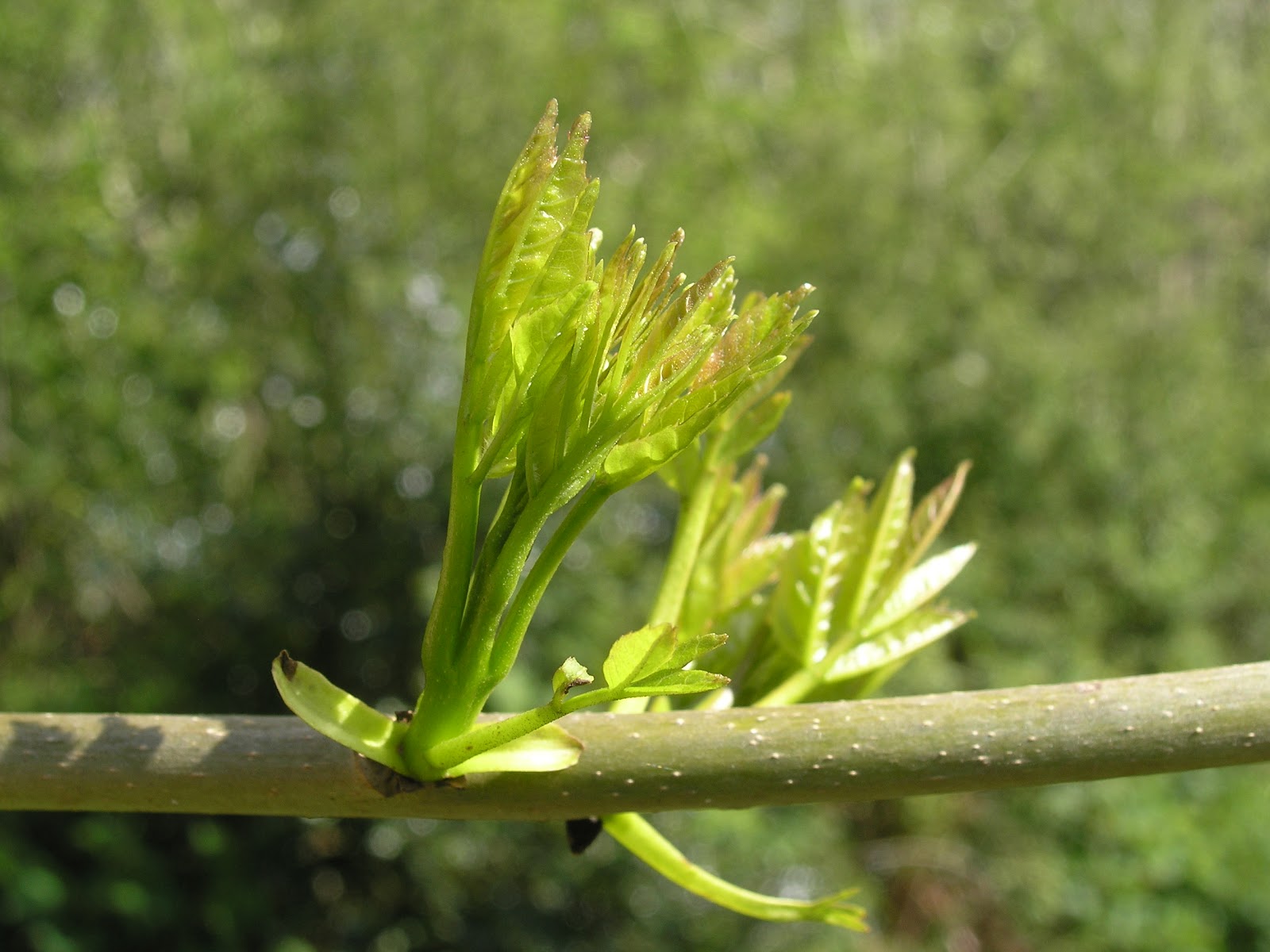
The hawthorn and sycamore have been in leaf for a week or more, ash buds are just opening now too. I was particularly struck by the colour of the new sycamore leaves; in sunlight they look almost like polished bronze.   

Thursday, 1 November 2012

Autumn blues

This sounds like the November morning blues, because it should start 'got up this morning'. I did, and when I drew the curtains the garden seemed to be full of birds.
Which is good, but also says winter is on the way. Lots of the activity was focused on the hawthorn hedge close to the house, where blackbirds and a mistle thrush were busy breakfasting on berries. 
Taking a closer look I spotted my first redwing of the season too. It was gulping down the shiny berries (are they called haws?) whole.
While I was watching it got through three one after another. Then it sat watching the world go by, presumably while all that fruit settled. Again this year the hawthorns are heavy with berries. The leaves are mostly gone now and from a distance the branches look red where the sun catches them.
Going around the garden this afternoon I have been feeling a bit blue though. When I picked my 'watched' tree back in spring I hadn't even heard of ash dieback; plenty of other tree-killers (and warnings about the damage they could do), but not ash dieback.
Now we know too much. We have so many ashes here that it is hard to imagine the landscape without them - they are 'the' Cych valley tree.
My watched tree is part of the our boundary hedge that is mostly ash. It has been cut and re-grown so many times that its base is so thick I couldn't get my arms around it.
It must have been there for at least as long as the house, which dates back to the 1880s, and possibly longer. Sad to think its days could now be numbered.   

Sunday, 30 September 2012

Indian Summer

It came, it went. We had one beautiful day of September sunshine yesterday and it was heavenly. A single world-weary small tortoisehell spent all day in the sun on the iceplant and there was a comma on the ivy that covers the old apple tree.
Comma (Photo: Tim Bekaert, Wiki Commons)
The comma had that mint condition new look about it as though it only just emerged. In the bright sunshine it looked so vividly orange that I decided I needed to take a photo, but of course by the time I had camera, memory card and batteries there was no sign of it.
It did get me to spend some time looking at the ivy and the dozens of flies of all kinds that were buzzing around the flowers on the sun-warmed side of the tree. There were so many of them that it really underlined what an important part late-blooming ivy plays at this end of the year.
I also had a look at my 'followed tree' for the first in a while. With hindsight it wasn't a good choice because you have to sight your way through nettles to get to it.
Hidden away in the vegetation the cut end of ash looks more than ever like the head of some sort of animal to me. The minotaur, maybe.
It's leaves are still mostly green, but they are starting to show signs of change. Brown spots are forming and leaf edges are curling.
And throughout the day there were swallows feeding over the valley. When I went into the garage after dark there was no sign of the last lonely fledgling that has been roosting on its own in there for a week or more - hopefully it joined up with the others and is now on it's way south.
 

Monday, 14 May 2012

New leaf

Some sunshine and a weekend, remarkable... It was good to get out and catch up on the lawn-mowing and spend some time seeing what's going on out there.
Finally something is happening with my "watched" tree. It's actually more a watched hedge as it happens, a big, mishapen old ash down by the compost heap.
It's surrounded by plant growth, but until the last day or two has shown no sign of responding to spring itself. That's now changing as, at last, buds are bursting.
The great thing about taking such a close interest in just one tree is that you do look so much closer than you'd normally do. So, I was a little surprised to see how buds are at different growth stages at different points on the tree.
Close to the trunk in the shadier part of the hedge the buds are only just beginning to swell, but further out at the tips of the branches new leaves are forming. For now the foot of the hedge in bathed in sunshine, but as the ash canopy forms overheard it's all going to be lost to shade.
Just now there's a bank of Red Campion, that catches the morning sun and is attracting insects. There are lots of bees and some butterflies too - including this green-veined white.  
Before I went to find the camera to take these photos I could hear the creaky-gate call of a young robin somewhere close by. One of its parents kept an eye on me from a distance.
It took some time looking into a tangle of brambles to spot it spot the newly-fledged youngster perched in a little pool of sunlight. Of course it goes without saying that by the time I was back with my camera it was nowhere to be seen. 


Friday, 30 March 2012

Dog's life

There's still no sign of anything happening with my 'followed' tree. The topmost buds of nearby ash trees are swollen and ready to burst, but my hedge ash is unchanged - unmoved by what looks, smells and sounds like spring to me.
But there's a lot going on around it. Hawthorn is coming into leaf and, around the ash's roots, the dog's mercury now has flowers. They're rather modest flowers and, so I read, have an unpleasant smell - not that I can detect it.
Dog's mercury is really a woodland floor plant, but a strip of it grows along the base of our garden hedge. Once the ash is in leaf it's an area that is nearly as shaded as the woodland floor would be.
I don't usually give it much attention, but as my tree was doing nothing I thought I'd read up on dog's mercury and now know that it is dog's mercury because it was said to be fit only for dog's.
Which is probably a good thing as it is one of Britain's more dangerous plants. Fit for dogs, dangerous to humans. The 17th Century herbalist Nicholas Culpepper said of it: 'There is not a more fatal plant, native of our country, than this.' Not one to pick up on any foraging expedition then.  

Sunday, 19 February 2012

Hedging my bets

After a lot of thought I've picked my follow-tree. A difficult choice to make it was too. I've plumped for a garden tree because I can visit it every day and have also gone for one that is usuallyoverlooked.
And the winner is... an ash that is part of our boundary hedge. Our garden is long and thin and slopes steeply, with the house at the top and this hedge is as far from the house as you can get.
I've looked at old maps and the house has been here since at least 1880 and this bit of hedge pre-dates it. Over the years it has been pruned back and it has been laid, so my tree is short and barrel-chested and has thick boughs that grow sideways from its trunk. It's like a mature tree that has been put on its side.
I cut it back pretty radically a couple of winters ago, so it has lots of growth from last summer coming out of it hedgehog-style, upwards and sideways.
Plenty of ivy growing on it too with a few berries that the blackbirds have left uneaten. No sign of the ash buds fattening up at the moment. But on the bank below things are happening; snowdrops are in bloom and the delicate shoots of what I think is dog's mercury are just starting to push through the soil.